Find information, resources and training opportunities to support health professionals to understand and use patient-reported measures (PRMs) in practice.
What are patient-reported measures?
PRMs are surveys that ask people about their healthcare experiences and the outcomes of their care. They provide insights that clinical data alone cannot capture.
PRMs fall into two categories:
PREMs capture a person's perception of their experience with healthcare or services.
PROMs capture a person's perspectives on how illness or care impacts on their health and wellbeing.
Using patient-reported measures
Modern healthcare can tell us a lot about a person without even talking to them, such as their heart rate, blood pressure, or admission history. However, it cannot tell us how they rate their quality of life or what matters most to them. To understand this we need to ask.
PRMs fill this gap by capturing the person’s voice. They help clinicians understand how people perceive their health and care, and they support shared decision-making and personalised care planning.
Evidence shows that:
- clinical indicators often don’t align with how a person feels
- people engaged in their own care tend to choose less costly, more appropriate interventions
- PRMs are especially valuable for conditions where quality of life is a key outcome.
By collecting and using PRMs routinely and systematically, health services gain a richer, more accurate understanding of patient needs and outcomes. This enables care teams to respond in real time, tailor treatment plans and improve service delivery in ways that truly reflect what matters to patients.
Success factors
To be effective, PRMs must be:
- reliable, valid and sensitive to detect change
- relevant and meaningful to patients and clinicians
- inclusive and culturally appropriate
- easy to use and not burdensome
- actionable at the point of care.
More about the evidence supporting the use of PRMs
Resources

- Video: HOPE demonstration for primary care clinicians
- Video: Demonstration for practice managers and administrators implementing HOPE
- Fact sheet: The digital collection and use of patient-reported measures
Information for clinicians about the benefits, key steps and considerations to support the digital collection and use of PRMs.
Training
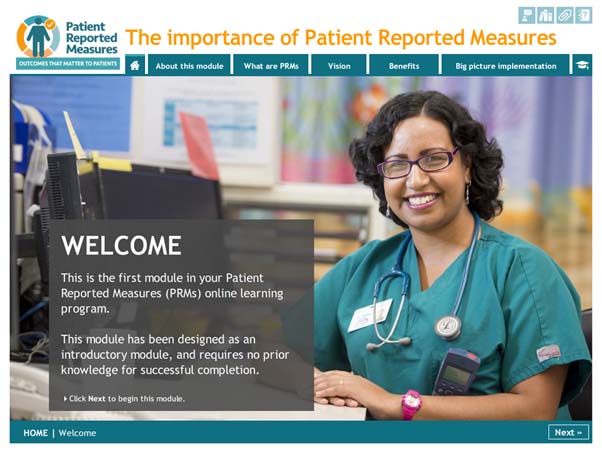
A series of online education modules have been developed to support the collection and use of PRMs in clinical settings.
The modules were developed in consultation with consumers, clinicians and managers at PRM Program sites. These modules were updated in 2024 for currency.
The education modules have been designed to introduce relevant topics in a quick and engaging way. The modules are free to access on the ACI learning management system.
You'll be prompted to register for a new account, set a password, log in and you're set to begin.
Patient Reported Measures education pathway
Overview of PRM modules
Clinical leads and service managers should complete modules 1-5. Clinicians and administrators should complete 1-3.
-
Module 1: Importance of PRMs
- What are PREMs and PROMs
- Vision
- Big picture implementation
-
Module 2: Clinical application
- PRMs in practice
- Identifying patient groups and question sets
- PRMs in clinical workflows
-
Module 3: HOPE module
- Understand how the Health Outcomes Patient Experience (HOPE) platform is used to improve patient reported measures
-
Module 4: Making it happen
- Project and change management
- Project governance
- Roles and responsibilities
- Implementation worksheet
-
Module 5: Creating positive change
- Identify trends
- Use in outcomes evaluation
- Use data to support quality improvement
-
Patient module
- How to complete PRMs
- How will my information be used
- How will my input improve health care?
- What happens to my information?

Online modules available
This module introduces PRMs, which capture information about your healthcare experiences and outcomes that matter to you. It is recommended for patients and consumers accessing healthcare services across hospitals, community and outpatient settings, primary care, and specialist clinics. The module should take approximately 15 minutes to complete.
For NSW Staff and Contingent Workers only.
This module introduces the role of PRMs within New South Wales Health and explores how they enhance patient-centred, value-based care. Participants will learn how PRMs – surveys completed directly by patients – provide vital insights into patients’ health outcomes, experiences, and what truly matters to them.
This is the first in a series of educational modules designed to support staff who are considering the implementation of PRMs.
Target audience: This module has been designed for clinicians, managers, administrative staff and patients from a range of healthcare settings, including primary care, speciality clinics and hospitals.
Module 2 aims to provide clinicians with the opportunity to explore the application of PROMs in a clinical setting. It uses an example of a clinical scenario to provide a step-by-step overview of the use of PROMs in clinical settings.
Target audience: This module has been designed for clinicians (nursing, medical and allied health) from a range of healthcare settings, including hospital clinics, general practices, specialist offices and community services.
The module is designed to introduce you to the HOPE platform.
You will see how the HOPE Platform enables the collection of PRMs, the different features and benefits of using HOPE.
Target audience: This module has been designed for clinicians, managers, administrative staff, carers and patients from a range of health care settings - primary care, specialty clinics and hospitals.
Module 4 covers a brief explanation of project and change management; insight into others' experiences of implementing PRMs; and the opportunity to start preparing your implementation action plan.
Target audience: This module has been designed for clinical leaders and managers who are interested in implementing PRMs.
Module 5 is designed to support staff who have implemented PRMs. Here you will find an overview of PRMs and how they can be used for quality improvement initiatives to create positive change.
Target audience: This module has been designed for clinicians, managers and administrative staff from a range of healthcare settings, including primary care, specialty clinics and hospitals.
Additional resources
Contact us
