The Port Kembla Hospital Physiotherapy Clinic, located in Illawarra Shoalhaven Local Health District (ISLHD), is an outpatient service that supports people recovering after knee replacement surgery.
The clinic offers a structured rehabilitation program that combines physiotherapy expertise with a group exercise model. Patients who have recently had knee surgery (usually within 6 weeks) are invited to join a 5-week program that includes 2 one-hour sessions each week in a supervised gym setting.
Each session includes a series of exercises designed to improve strength, movement, balance, and everyday activities like walking and standing. While sessions are delivered in a group setting, each patient follows an individualised program with exercises adjusted to their ability and progress. Patients also receive a booklet to continue exercises at home.
The clinic’s group-based approach allows more patients to be treated at the same time, helping to reduce waiting lists while maintaining good recovery outcomes. Patients can still receive one-on-one follow-up if needed. Overall, the clinic provides a practical, supportive, and efficient way to help people recover and return to daily life after surgery.
In 2025, the clinic began using patient-reported measures (PRMs) so that patients could share directly how they were feeling and functioning during recovery. These included 2 patient-reported outcome measures (PROMs):
- the Oxford Knee Score (OKS) which assesses knee pain and function
- the Patient-Reported Outcomes Measurement Information System 29 (PROMIS-29), which measures overall wellbeing and quality of life.
These PROMs help clinicians track progress, tailor care to individual needs, and identify if additional support or referrals are required. They also provide reliable data to monitor overall outcomes and continuously improve the service.
Patient-reported measures workflow
-
Post–total knee replacement patients are referred to outpatient physiotherapy and enrolled in the program.
-
Clinicians collect PROMs (OKS and PROMIS-29) via the HOPE platform at the initial appointment.
-
Clinicians use PROMs results to inform individualised rehabilitation goals and group exercise planning.
-
Patients participate in a structured group physiotherapy program with ongoing monitoring of progress.
-
PROMs insights support adjustments to exercise intensity and identification of patients needing additional input or referral.
-
PROMs are re-collected toward the end of the intervention to assess change in outcomes.
-
Clinicians analyse pre-and post-PROMs data to evaluate patient improvement and program effectiveness.
Consumer story
Jo*, a 68-year-old patient undergoing total knee replacement, participated in a 5-week group rehabilitation program aimed at restoring mobility and independence. PROMs played a key role in tracking progress, with Jo’s OKS improving from 24 to 33 and PROMIS-29 showing significant gains in physical function and reduction in pain, fatigue and interference.
Reflecting on the program, Jo shared, “I’m not a motivated person, so being in a group helped.”
These outcomes, alongside functional improvements, highlight how PRMs guide care and demonstrate meaningful recovery, supporting the patient to achieve goals including independent mobility and return to daily activities.
* Name has been changed for patient privacy.
Benefits of patient-reported measures
Benefits for the patient
- Patients experience clinically meaningful improvements in pain and function.
- Patient outcomes indicate enhanced recovery, independence and quality of life, including:
- a perceived improvement on the OKS for 23 patients who completed the PROM. From March to November 2025, the OKS increased by an average of 7.39 points, exceeding the threshold for perceived improvement.
- gains over the same time period in range of motion, reduced pain (PROMIS-29); faster mobility (the Up and Go improved by approximately 8 seconds); and reduced reliance on mobility aids (22 out of 26 patients were independently mobile compared to 6 at baseline).
Benefits for the service
- PROMs (OKS, PROMIS-29) collected via the HOPE platform are central to monitoring outcomes, guiding clinical decision-making and tailoring rehabilitation.
- PRMs enable clinicians to track progress, optimise exercise intensity and identify patients requiring additional or alternative interventions, including referral to other disciplines.
- They also support continuous evaluation and refinement of the group model using data-driven improvement methods.
Benefits for the organisation
- PRM-enabled, group-based care can deliver equivalent or better outcomes more efficiently, improving access and reducing waitlists without additional staffing.
- PRMs support scalable, data-informed models of care, embed digital measurement into routine practice, and strengthen system sustainability through cost savings and increased throughput.
- The group class, embedding PROMs and other outcomes, provides a transferable framework for other musculoskeletal and elective surgery pathways across ISLHD.
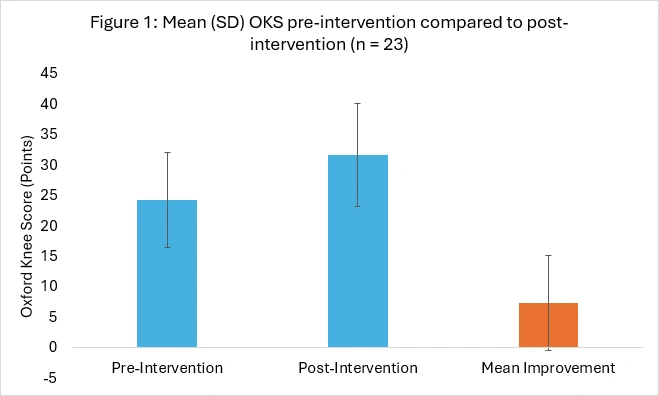
Oxford Knee Scores (OKS) improved notably post-intervention, with mean scores increasing from approximately 24 pre‑intervention to around 32 post‑intervention. 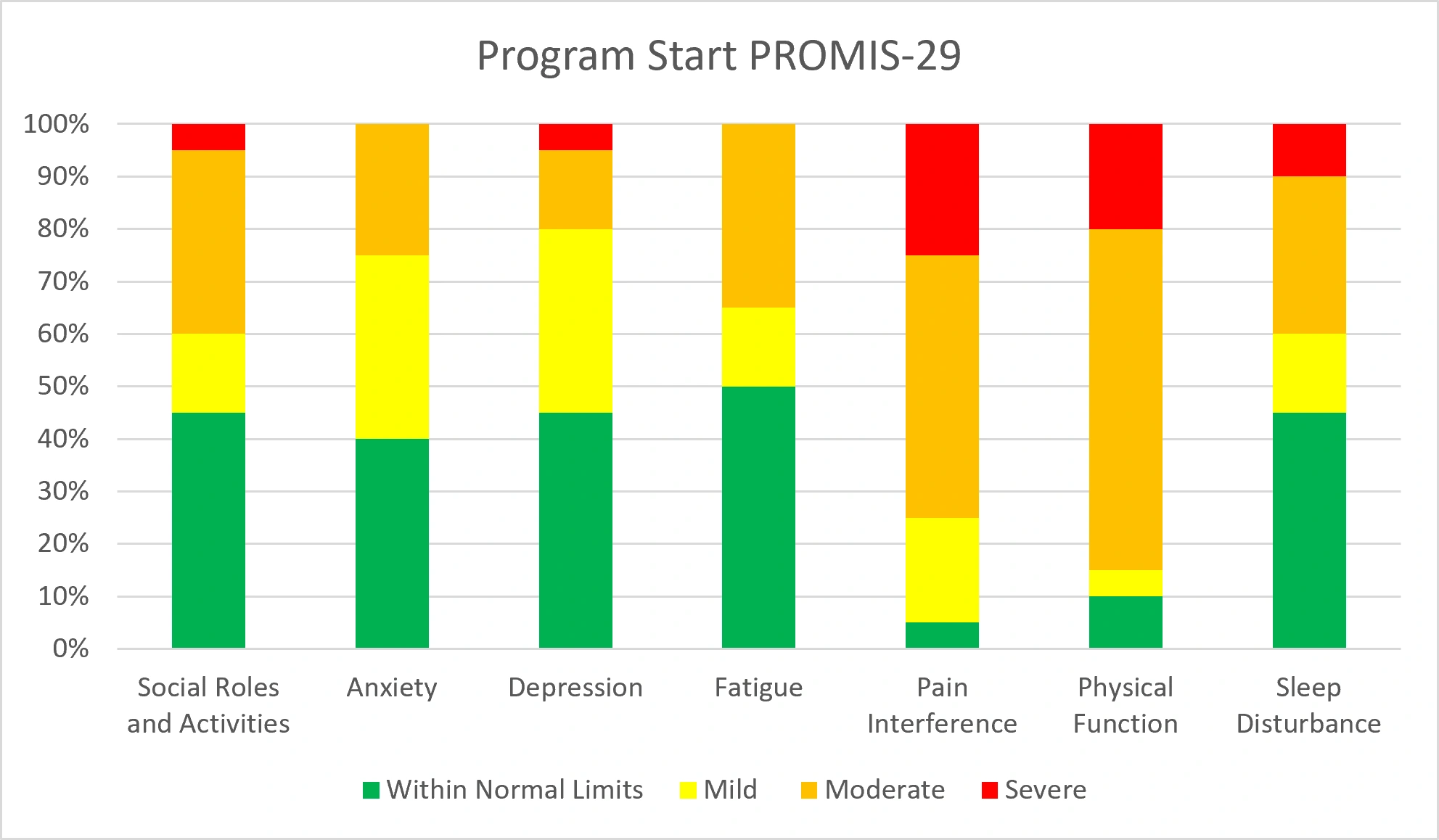
PROMIS-29 scores at the start of the program 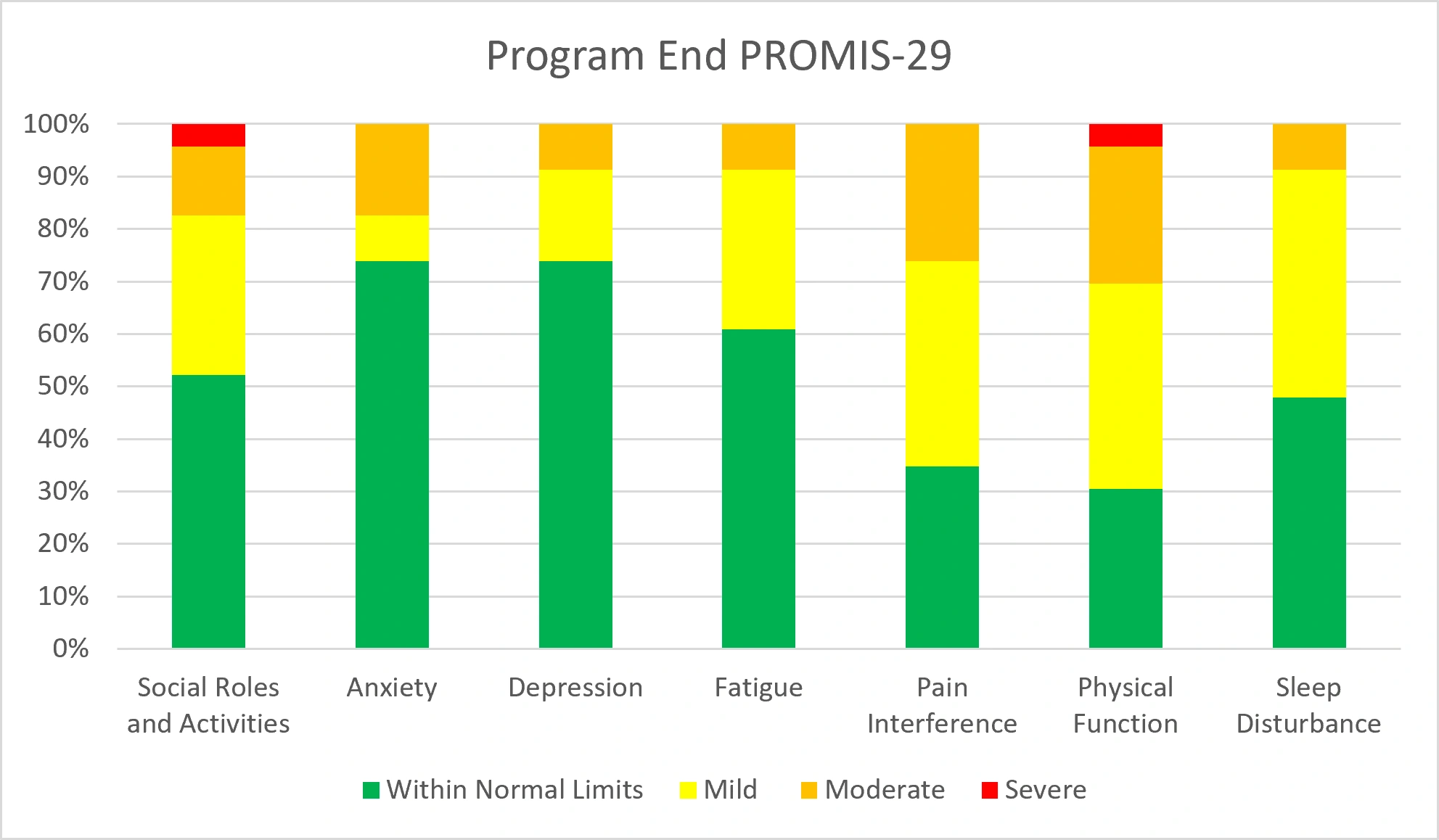
PROMIS-29 scores at the end of the program Helpful tips for other services
Make PROMs business as usual – build them into routine assessments at a standard timepoint.
Go digital from day one – use platforms like HOPE for real-time capture, easy access and low admininstrative burden.
Turn data into action – use PROMs to tailor care, trigger referrals and prove impact through outcomes and service improvements.
Clinical engagement approach
- PROMs implementation at Port Kembla Hospital was strategically timed so go-live aligned to the first post-surgical rehabilitation cohort of 2025. This supported early integration into patient pathways.
- ISLHD PRM Leads adopted a structured implementation approach, embedding the OKS and PROMIS-29 PROMs that were already in use in the Osteoarthritis Chronic Care Program (a clinical program for people with osteoarthrisis, before or while they wait for joint replacement surgery). This enabled continuity and longitudinal outcome tracking across pre-and post-surgical care.
- Clinician training and capability building was a key focus, including education on PROMs selection, clinical relevance and interpretation to support integration into routine care and decision-making.
- PRMs Leads provided targeted training on the HOPE digital platform to support electronic collection. This ensured administrative staff and clinicians were confident in administering, accessing and using PROMs data at the point of care.
- Implementation prioritised workflow integration, with PROMs embedded into existing outpatient physiotherapy processes to minimise administrative burden and promote sustainability.
- PRMs Leads supported clinicians to understand the value of real-time, standardised patient-reported data in monitoring outcomes. This has enhanced patient-centred care and informed service improvement.
- Ongoing support and engagement has ensured data quality, clinician uptake and continuous improvement, reinforcing PRMs as business-as-usual practice within the service.
Organisational structure

Governance
- The Clinical Governance Unit leads the implementation and oversight of the PRMs program within ISLHD, with executive sponsorship provided by the Director of Clinical Governance, Patient Strategy and Quality.
- Program governance is supported through a clear reporting structure, with PRMs Program Leads reporting to the Senior Manager, Quality Systems and Improvement, who reports to the Director of Clinical Governance.
- PRMs Program Leads contribute to organisational oversight by providing bi-monthly reports to the district National Safety and Quality Health Service Standard 2: Partnering with Consumers Committee. This ensures alignment with consumer-centred care priorities.
- At the service level, quarterly engagement with clinical teams collecting PROMs supports implementation, data interpretation and continuous quality improvement. District-wide communication is maintained through formal channels including targeted email updates.
- Program accessibility and transparency are supported through a dedicated PRMs intranet page, which provides staff with resources, guidance and contact information.
- For consumers and the broader community, the PRMs program is reported about in the publicly available ISLHD Annual Safety and Quality Account, promoting awareness and accountability.
- This governance and communication framework ensures that PROMs are embedded into routine practice, supporting consistent data collection, organisational learning and the use of patient-reported data to inform service evaluation and improvement.
Acknowledgements
We acknowledge and thank the following ISLHD team members for their contributions to this project:
- Jayden Smileski, Physiotherapist, Musculoskeletal Outpatients
- Christofer Sandell, Physiotherapy Team Leader
- Sonja McDonald, Administration Officer, Musculoskeletal Outpatients
- Maira Gee, Acting Physiotherapy Unit Head
- Narelle Panta, Quality and Accreditation Manager
- Ross Arie Barcena, Patient Reported Measures Program Manager
- John Paul Troiani, Patient Reported Measures Program Manager