The Aunty Jean’s Chronic Disease Program is provided by the Illawarra Shoalhaven Local Health District (ISLHD) Aboriginal Chronic Care Unit. It provides health promotion, education and self-management to support and sustain the development of good health behaviours and strategies for Aboriginal and Torres Strait Islander people with chronic and complex care needs.
Chronic disease is a major factor contributing to higher mortality, increased hospitalisations and reduced quality of life for Aboriginal and Torres Strait Islander people. Aunty Jean’s has been running for more than 20 years in ISLHD, with groups meeting weekly in Berkeley (Illawarra), Nowra and Ulladulla (Shoalhaven). The program was named in memory of past respected Elder Aunty Jean Morris, who promoted Aboriginal health and culture.
On attendance at the group, participants receive a personal health check and help with setting or monitoring goals to improve their health. The program began collecting patient-reported measures (PRMs) in 2015 and went live on the Health Outcomes and Experiences (HOPE) portal in 2021.
Collection of the PROMIS-29 quality of life survey supports the NSW Health vision and transition from volume-based to value-based care. It shifts the conversation between Aboriginal health staff and participants from “What’s the matter with you?” to “What matters to you?”
In 2024, the Aunty Jean's leadership adopted a new process across all groups, shifting from bulk collection of surveys every six months to collecting surveys from two participants each week to enable all participants to complete the PROMIS-29 approximately every six months. This allows for more continual use of the HOPE platform and iPads to maintain staff skills and for participants with more complex needs to complete surveys more regularly as clinically indicated.
Since June 2021, 106 Aunty Jean’s participants across the district have been registered in HOPE, with 159 patient-reported outcome measures (PROMs) completed as at July 2024.
Patient-reported measures workflow
-
Staff receive training including an introduction to PRMs (and the case for change), PROMIS-29 and the HOPE portal (inclusive of educational videos produced by the PRMs Leads), as well as HETI suicide prevention training and mental health service support available.
-
Program nurses triage participants weekly.
-
Nurses collect the PROMIS-29, a quality of life PROM at point of care during the participant’s first health check, then every six months.
-
Nurse invites the participant to be included in the case conference, to share high risk concerns that may need immediate support from the team.
-
Aunty Jean’s facilitator reviews the participant's PROM results following the weekly group session.
-
Facilitator arranges follow-up for appropriate action with the participant, e.g. referral, case discussion with service.
-
Facilitator documents PROMIS-29 results and any actions required in eMR, and provides a letter confirming these to the participant's care provider (e.g. GP, mental health, aged care, NDIS).
Consumer story
Arthur, a 64- year old male participant in the Aunty Jean's program, completed a PROMIS-29, which showed signs of depression and high levels of pain. He discussed the results with the facilitator and explained the situation in more detail. A call to the statewide Mental Health Line and sharing these results with mental health practitioners kickstarted a prompt mental health home assessment.
Following this intervention, at the following group session the facilitator could clearly see that Arthur showed improvement in the impact and management of pain, and was in better mental health. The facilitator supported him to participate in the Get Healthy program, which offers phone coaching sessions to maintain general healthy lifestyle. This example is a great response from the district’s mental health services and strong referral pathways now in place.
*Name has been changed for patient privacy.
The reason consumers are loving it is because they are seeing their PROMIS -29 results too, and they can follow their improvements.
Benefits of patient-reported measures
Benefits for the patient
- PRMs help to identify areas of most concern for a participant, which may prompt referral to other professionals, e.g. GP for a mental health care plan, or local chronic pain management service.
- PRMs help to inform treatment goals and individualised planning. They allow the Aunty Jean’s team to evaluate individual treatment effectiveness holistically, as staff do not provide direct care for the participants’ chronic health conditions.
- Particpants are invited to the case review discussion with their healthcare team, which promotes increased engagement and shared decision making.
- Based on the results of the PROMIS-29, participants are able to receive tailored resources and information that support and align with their needs.
Benefits for the service
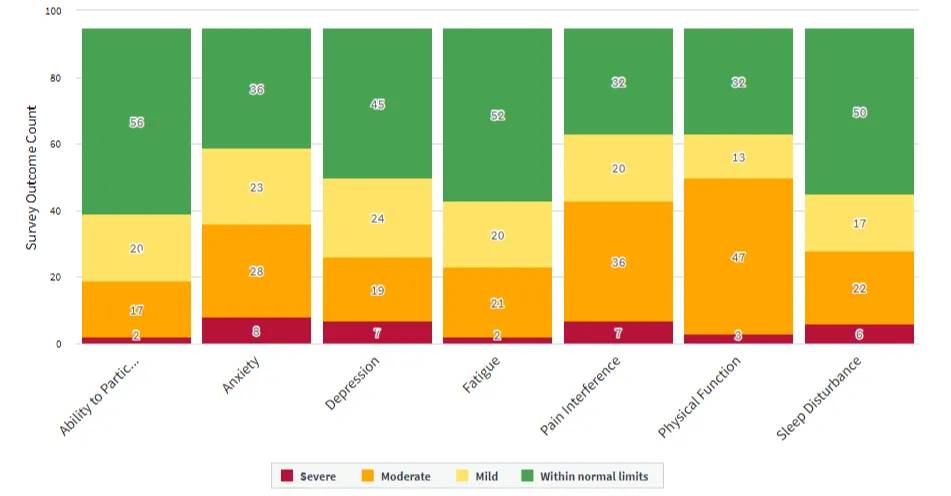
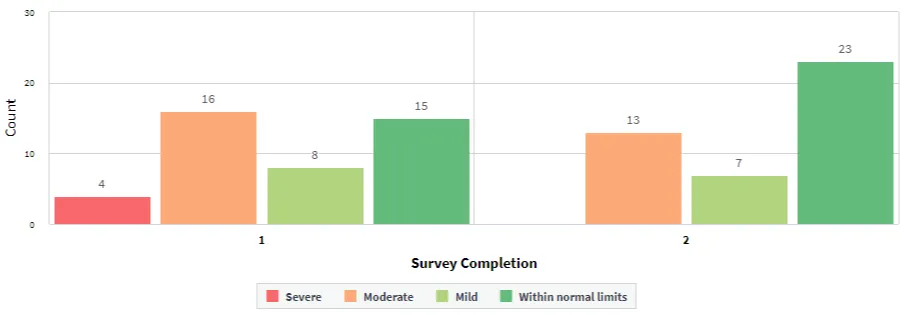
- Aunty Jean's has completed an analysis on aggregated data, which showed that 65% of all participants reported pain interference that was worse than normal, and that 45% felt that their pain was moderate or severe (see Figure 2 below). These findings led to staff education in pain management and improved referral pathways for more severe issues. Aboriginal Health Care Workers attended a two day Pain Management workshop created by Professor Michael Nicholas. Following this, there was a 10% reduction in the number of participants reporting their pain as being worse than normal (55%). When comparing first and subsequent surveys, there is a significant improvement in the impact of pain on quality of life (see Figure 3). There was a 100% decrease in the number of participants reporting severe impact and a 25% decrease in those reporting moderate impact of pain on quality of life (see Figure 3).
- The Aunty Jean's service team has participated in additional mental health training which has supported increased capability in supporting and responding to client needs. All staff reported feeling confident in collecting the PROMIS-29 survey and discussing the outcomes with participants in a post-training survey.
Benefits for the organisation
- ISLHD is currently looking to expand its implementation of the Aboriginal Health clinical program in HOPE to other locations and services across the district. In June 2024, PRMs was implemented in the Koori Men’s Group at Albion Park. Further discussion and planning is required to consider next implementation locations. The Aboriginal Chronic Care Unit is also looking at how aggregated PRMs can be integrated in reporting for the local Aboriginal Health Strategy.
Helpful tips for other services
Ensure a clear workflow and collection procedure is in place, which is least disruptive to group activities and dynamics. Be willing to adapt this upon review.
Provide face-to-face staff training where possible. This provides the opportunity for authentic yarning about the challenges of implementing and sustaining HOPE for Aboriginal health workers and practitioners and to reflect on feedback from participants.
Be open to modifying PRMs workflow over time, ensure regular reviews to look for areas of improvement, and involve consumers in the process.
Clinical engagement approach
ISLHD PRM leads took a collaborative approach to implementation with Aunty Jean’s, providing the following support:
- Working closely with staff and managers to understand the service, and identify opportunities and culturally appropriate methodologies for using PRMs within established workflows.
- Organising training based on service needs and preferences, including training on the HOPE platform to build user confidence prior to go-live, and the use of iPads for Aboriginal health workers and clients.
- Demonstrating the power of real-time, electronic validated and standardised data to streamline reporting and benchmarking, and enhance service quality and safety.
- Providing onsite support at go-live, and ongoing a required. This included helping participants when navigating unfamiliar technology and helping them understand the PROMIS-29.
- Additional training post go-live has been provided to facilitators with a strong emphasis on mental health education, psychological safety of staff, screening and establishing appropriate referral pathways to support the embedding of PRMs.
Organisational structure

Governance
The Clinical Governance Unit manages the implementation of the PRMs program in ISLHD. The Executive Sponsor of PRMs is the Director Clinical Governance (DCG), Patient Strategy and Quality. The PRMs Program Leads report to the Senior Manager, Quality Systems and Improvement, who reports to the DCG.
The PRMs Leads provide a report bi-monthly at the District National Standards for Quality and Safety in Healthcare Standard 2 Partnering with Consumers committee meetings. The Leads meet quarterly with individual services collecting PRMs and communicate to the broader LHD through communication channels such as district-wide email. The PRMs intranet page is available to all staff in ISLHD and provides program information and team contact details.
Consumers can read about the PRMs program in the ISLHD annual Safety and Quality Account Report which is a public facing document available on the district’s internet site.
Acknowledgements
- Rebecca Dawson, Senior Aboriginal Health Coordinator, Aboriginal Chronic Care Unit
- Beverley Crowther, Principal Aboriginal Health Worker
- Michelle Wellington, Principal Aboriginal Health Worker
- Daniel Dawson, Principal Aboriginal Health Worker
- Susan Downs, Exercise Physiologist
- Savina Iskra, Diabetic CNC/Registered Nurse
- Zane Rice, Manager, Aboriginal Chronic Care Unit
- Kish Verdejo, ISLHD PRM Program Manager
- John Paul Troiani, ISLHD PRM Program Manager
- Sharlene Narayan, ISLHD PRM Program Manager