Published: February 2025. Next review: 2030.
The Preoperative Education and Prehabilitation Program (PrEPP) at Nepean Hospital uses videoconferencing to deliver an exercise and diet regimen to patients scheduled for abdominal and thoracic surgery, before their operation.
This program is designed to optimise the patient's physical and emotional wellbeing, positioning them for improved outcomes after surgery. Patient's can choose to complete the program virtually or in person. It runs for 2 to 6 weeks, based on patient needs.
The PrEPP aims to:
- improve quality of life
- improve postoperative recovery
- reduce hospital length of stay
- minimise unplanned intensive care unit admissions
- reduce hospital readmissions.
Reasons for change
- Research indicates that prehabilitation before major surgery can result in faster recovery, improved health outcomes, enhanced patient experiences and cost savings for the healthcare system.
- The impact of COVID-19 meant that many patients were not able to receive the benefits of prehabilitation, highlighting the need for different ways to access it.
- Introduction of the virtual PrEPP ensures patients can participate in an evidence-based prehabilitation program, regardless of location, mobility or personal preferences.
Patient feedback
Patient feedback has informed service updates and enhancements, such as simplifying the patient handbook. A practical ‘dos and don’ts’ section was added, along with important post-surgery information.
"I thought doing those exercises would have gotten me in trouble and rest was necessary. However, the exercises helped me get out of bed and reduced my hospital length of stay."
"Improved my confidence going into surgery by helping me get stronger and better informed."
"You can never be prepared enough for surgery and this program helps both physically and mentally."
Clinician feedback
My patients always give me positive feedback about the prehabilitation program, especially how convenient it is to get it via virtual care. Time is critical for our cancer patients, where travelling to the hospital, parking, etc. are always a deterrent for them to attend the clinics. Virtual care has been very valuable for these patients.
Workflow
-
Referral
Referral is received from surgeons' room. -
Appointment
Patient is contacted and appointment made. -
Assessment
Initial assessment (in person) is completed by physiotherapist, physician and dietitian. Assessment includes anthropometrics, strength, endurance and vital signs. -
Provide education resources
Materials are provided to the patient, e.g. booklet, exercise diary and, if needed, a tablet on loan. -
Group exercise
Group exercise sessions are scheduled for twice-weekly. Involves 60-minute exercise sessions via smart device, supervised by physiotherapist. Patient moves through their own tailored program during the group sessions. -
Education sessions
Education sessions are provided (pre-recorded) for patient to watch at their convenience.
Key enablers
Patient resources
The following patient resources are available to support participation in the program:
- Patient information booklet
- Exercise diary
- Exercise handout
- Education component (in booklet and recorded PowerPoint presentations on USB)
- benefits of exercise
- diet and nutrition
- smoking cessation
- postoperative pain control
- postoperative complications
- Incentive spirometer
- Inspiratory muscle trainer
- Exercise bands
Impacts and outcomes
Patient benefits
- Access to the prehabilitation service from remote locations
- Improved patient satisfaction
- Convenience and comfort of receiving intervention at home
- Time and cost savings
Patient satisfaction survey results
Data source: Locally administered program evaluation surveys.
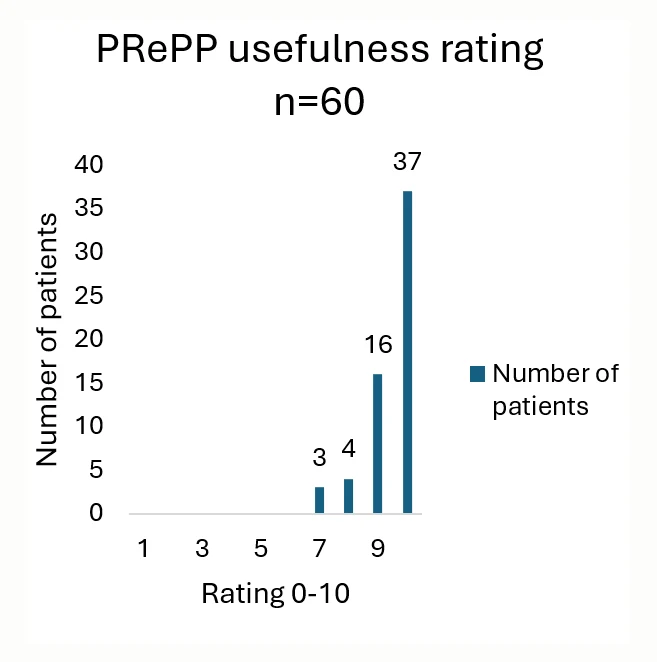
PRePP usefulness rating
In a survey - 60 patients were asked to rate the program between 1-10
- 37 patients gave the program a score of 10
- 16 patients gave the a score of 9
- 4 patients gave a score of 8
- the remaining 3 patients gave a score of 7
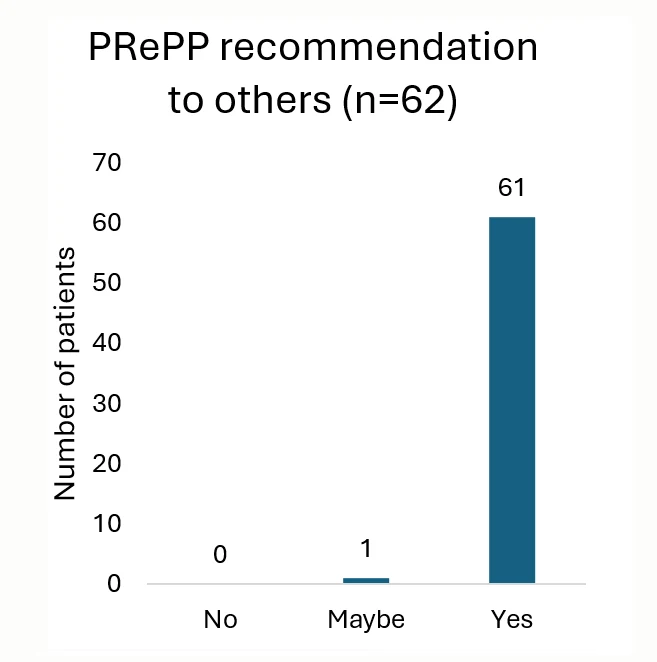
PRePP recommendation to others
In a survey 62 patients were asked if they would recommend the program to others.
61 patients responded with "yes", 1 patient responded with "maybe".
Clinician benefits
- Reaching patients who otherwise may not attend
- Flexibility of timing
- Provides an option if gym space or clinical areas are unavailable or limited
Service benefits
- More patients are captured.
- Improved service deliverability.
System benefits
- Cost effective. An estimated annual cost saving of $566,000 at Nepean Hospital.
- Reduced intensive care unit admissions, hospital length of stay, postoperative complications Prehabilitation patients had a shorter hospital length of stay (8.5 days) compared with non-prehabilitation patients (10.2 days) and spent less time on mechanical ventilator post-surgery, compared with non-prehabilitation patients.
- Reduced carbon footprint. By reducing the hospital length of stay and through the use of virtual care, the total saving calculated was equivalent to 289.3 tonnes of CO2.
Research initiatives
The virtual program's effectiveness, compared to the usual in-person program, is being investigated via a randomised controlled trial. This research is supported by a Sydney Health Partners Implementation Science Pilot Grant.
Future vision
The PrEPP patient cohort in NBMLHD could be broadened to include additional surgeries and services, such as complex ear, nose and throat surgeries and breast cancer-related surgeries, e.g. mastectomies.
The program could be adopted or adapted by other local health districts across NSW.
Acknowledgements
We acknowledge the following people from NBMLHD for their support and information provided for this Spotlight.
- Tanya Baldacchino, Virtual Care Manager
- Shelley Boyle, Head of Physiotherapy
- Josh Dardo, Physiotherapist
- Trang Sorino, Senior Dietitian
Contact
For more information, contact Anwar Hassan, Clinical Specialist Physiotherapist, Nepean Hospital anwarul.hassan@health.nsw.gov.au