Who can perform bladder irrigation, the relevant guidelines that must be followed, required documentation, and patient care considerations.
Bladder irrigation involves flushing the bladder with a sterile solution to prevent blood clot formation, maintain urinary catheter patency, and ensure the free flow of urine. It is usually performed following urological surgery, or when haematuria or blood clots are present.
Bladder irrigation is generally not recommended in community or home settings due to limitations in equipment, staffing and escalation pathways. In exceptional circumstances, such as patients with spinal cord injury experiencing autonomic dysreflexia or patients receiving end-stage palliative care, bladder irrigation may be considered in the community. In these cases, clinicians must follow local policies and escalation processes.
Separate clinical guidance should be developed for community practice to ensure safety and compliance with relevant guidelines.
This resource is not intended for use in maternity settings. In these settings, bladder irrigation should only be undertaken following medical assessment and in accordance with local maternity and local health district (LHD) policies.
Health professionals who can perform bladder irrigation
The following health professionals can perform bladder irrigation:
Medical officers
Registered nurses (RNs) and higher-grade nursing positions
Accredited endorsed enrolled nurses
Undergraduate student nurses under the direct supervision of an RN who has been assessed as competent (at the discretion of the university the student attends and local LHD guidelines)
Documents the order and clinical indication for bladder irrigation in clinical progress notes
Reviews the bladder irrigation at least daily
Responds to escalation for review
Registered nurse
Maintains patient comfort
Educates the patient on the bladder irrigation process
Ensures urinary catheter patency and that urine drains freely
Monitors the degree of haematuria and the presence of clots, adjusting the irrigation fluid infusion rate accordingly
Ensures an adequate supply of infusing fluids is nearby and stored at room temperature to avoid bladder spasm
Completes documentation (accurate record of urine output, urine colour and degree of haematuria, presence of clots, and whether manual bladder irrigation was required)
Completes documentation at least daily and adjusts medical order as required
Provides catheter care, securing the indwelling urinary catheter (IDC) appropriately to minimise movement
Escalates to medical officer for review if worsening haematuria or unable to maintain catheter patency
Note: Nurse practitioners who are authorised within their specialty scope can assess the need for bladder irrigation, order the procedure and provide ongoing management of bladder irrigation.
Competency
All health professionals performing bladder irrigation should have completed a clinical skills or competency assessment. They must demonstrate the necessary knowledge, understanding of associated risks and competency to the standard required by the LHD or healthcare provider.
Compliance with relevant guidelines
Health professionals should follow the LHD or healthcare provider’s guidelines on urinary catheterisation and bladder irrigation. The following guidelines should also be followed:
Medication Handling (PD2022_032) Standards for the procurement, storage, prescribing, supply, dispensing, administration and documentation of medications in NSW public health facilities.
Compliance with these guidelines will:
maintain urinary catheter patency
improve patient comfort
prevent or minimise blood clot formation
reduce risk of CAUTI.
Required documentation
When performing bladder irrigation, the following documentation is required.
Clinical progress notes:
Indication/order for irrigation, e.g. post transurethral resection of the prostate (TURP) or transurethral resection of bladder tumour
Report on clot retention, haematuria and catheter blockage
Method of bladder irrigation (continuous bladder irrigation, intermittent bladder irrigation via irrigation pump bag and manual bladder irrigation)
Complications, e.g. bladder spasm, lower abdominal pain, leakage around catheter, negative fluid balance
Medical review at least daily
Order for irrigation to cease
Fluid balance chart:
Amount of irrigation fluid instilled
Urine output
Degree of haematuria
Presence of clots
True urine output is measured by subtracting the volume of irrigation fluid instilled from the total volume emptied. For example, if the patient has had a 2 L irrigation bag instilled and the total output is 2400 mL, the true urine output is 400 mL (2400 mL output – 2000 mL irrigation fluid).
Clinicians may choose to record patient information in a bladder irrigation chart before entering the information into the electronic medical record.
Three-way catheters
Three-way urinary catheters are used in bladder irrigations. A 3‑way standard (round) tip catheter has 3 ports, these are:
irrigation channel
drainage channel
balloon channel.
A 3‑way whistle tip catheter has the same ports but a differently shaped tip, which is open and bevelled to facilitate drainage of blood clots. Insertion of whistle tip catheter is usually performed by urologists or urology registrars.
Patient care considerations
Clinicians should be aware of the following signs and symptoms of a blocked catheter:
No urine flow from the catheter
Suprapubic distention and lower abdominal pain, becoming more pronounced as the bladder fills
Urine leaking around the catheter (bypassing)
Development of vasovagal symptoms, such as sweating, tachycardia and hypotension
Autonomic dysreflexia in patients with a spinal cord injury at or above T6 level. This is a medical emergency characterised by a sudden and dangerous rise in blood pressure.
Drag the table right to view more columns or turn your phone to landscape
Issue
Actions
Leakage around the catheter (bypassing)
Assess for obstruction.
Assess for bladder spasm.
Avoid cold irrigation fluid.
Ensure the IDC is secured to the patient’s thigh to minimise catheter movement.
The patient is experiencing pain
Turn off the irrigation and check for kinks, loops or clots in the catheter or drainage bag tubing.
Assess the bladder for distention via palpation.
Performing a bladder scan may be useful to determine bladder volume (if bladder scanner is available).
Check drainage to determine if output is adequate.
The amount of drainage is less than the irrigant instilled
Turn off the irrigation and check for kinks, loops or clots in the catheter or drainage bag tubing.
Palpate the bladder and note any patient pain or discomfort.
Performing a bladder scan may be useful to determine bladder volume.
Try ‘milking’ the IDC to dislodge clots.
Check the height of the IV pole and for overflowing of the drip chamber (can affect patency).
Recalculate the true output, i.e. subtract the volume of irrigation fluid instilled from the total volume emptied for the true output volume.
Use of a closed intermittent irrigation system (preferred) or manual irrigation may be required if obstruction is the cause (refer to facility guidelines). If unsuccessful, notify the relevant medical officer.
There is an increase in haematuria or clots present
Increase the infusion rate and observe the drainage and patient comfort.
Use of a closed intermittent irrigation system (preferred) or manual irrigation may be indicated to aid in clot evacuation if obstruction is suspected (refer to facility guidelines). If unsuccessful, notify the relevant medical officer.
The patient becomes confused or agitated post-TURP
TURP syndrome occurs when there is an overload of irrigation fluid through the prostatic sinuses during the operative procedure. This can lead to confusion, hypertension and hyponatraemia. This is uncommon.
Assess patient for orientation to time, person and place and notify relevant medical officer of patient’s changed status.
Ensure relevant information is available for the medical officer to review, including:
time of change in orientation
administration of any pain relief
amount of irrigant instilled and true output (subtract the volume of irrigation fluid instilled from the total volume emptied for the true output volume).
Manual irrigation
Manual bladder irrigation involves flushing a 3-way or 2-way urinary catheter manually with sterile sodium chloride 0.9% using a catheter-tipped syringe to evacuate all clots.
Manual irrigation may be followed by continuous bladder irrigation to minimise the risk of further clot formation and overdistention of the bladder.
The optimal outcome is removal of clots from the bladder, with the urine draining freely. Some sub‑optimal outcomes include the following:
Overdistention of the bladder.
Bladder rupture.
Inability to clear clot in bladder, which may require catheter replacement or surgical removal of the clot. Consider replacement with a larger gauge (with larger drainage holes) or 3-way catheter, if the blocked catheter was a smaller gauge or a 2-way catheter.
Development of a catheter-associated urinary tract infection (CAUTI) secondary to contamination during the procedure.
Development of a CAUTI secondary to a break in the closed urinary drainage system and possible contamination during the procedure.
Manual irrigation must be gentle, as the increased pressure in the bladder can result in suture disruption or bladder perforation with resultant extravasation of urine.
Use sterile equipment and aseptic techniques for this procedure.
Before undertaking the procedure, the nurse, medical officer or student should be able to demonstrate an understanding of the procedure and be able to carry it out safely, in accordance with the standards and protocols established by the local health district (LHD) or healthcare provider.
Ordering and documenting manual bladder irrigation
While not contraindicated in patients who have had deep resection of bladder tumours, open bladder or renal transplant surgery, manual bladder irrigation must be ordered and documented by a urology medical officer or practitioner and be performed by an experienced clinician.
Documentation should include the reason for irrigation, volume instilled and returned, presence of clots or debris, patient tolerance, catheter patency post-procedure and any escalation.
If the catheter is blocked and the patient is within 72 hours of urological surgery, notify the urology registrar or consultant urologist. This is important following a transurethral resection of prostate (TURP) due to the risk of prostatic capsular perforation or sub‑trigonal catheter placement on reinsertion. It is also important following radical prostatectomy and bladder resection due to the risk of possible damage to surgical anastomosis and bladder perforation.
Nursing staff (unless an experienced urology nurse) and resident medical officers must not attempt re‑catheterisation unless authorised by a urology registrar or consultant urologist.
Equipment
Personal protective equipment (PPE)
Alcohol‑based hand rub
1 sterile catheter pack, a sterile dressing pack, or similar, to provide a sterile field
1 sterile kidney dish or sterile receptacle of at least 1 L volume (pending pack inclusion)
1 sterile catheter-tip 50 mL syringe
Cleaning wipes, as per LHD supply and environmental cleaning protocols
6 x alcohol swabs, as per LHD supply (70% alcohol swabs, or 2% chlorhexidine and 70% alcohol swabs)
1 bottle 500 mL sterile sodium chloride 0.9%
1 sterile urinary drainage bag
Disposable underpad
Sterile gloves
For clean, no-touch technique: a clean, non-sterile receptacle placed on lower shelf of the trolley, or on a separate trolley for drainage collection
For sterile technique: an additional sterile kidney dish or sterile 1 L jug positioned within the sterile field.
Catheter pack may not be available. Inclusions in catheter packs vary across LHDs. Two sterile kidney dishes or receptacles are required for this procedure.
Manual bladder irrigation procedure
Manual bladder irrigation aims to remove clots, restore urinary drainage and maintain catheter patency. Throughout the procedure:
maintain aseptic technique
minimise contamination
support patient comfort and safety
accurately document outcomes and fluid balance.
Continuous irrigation
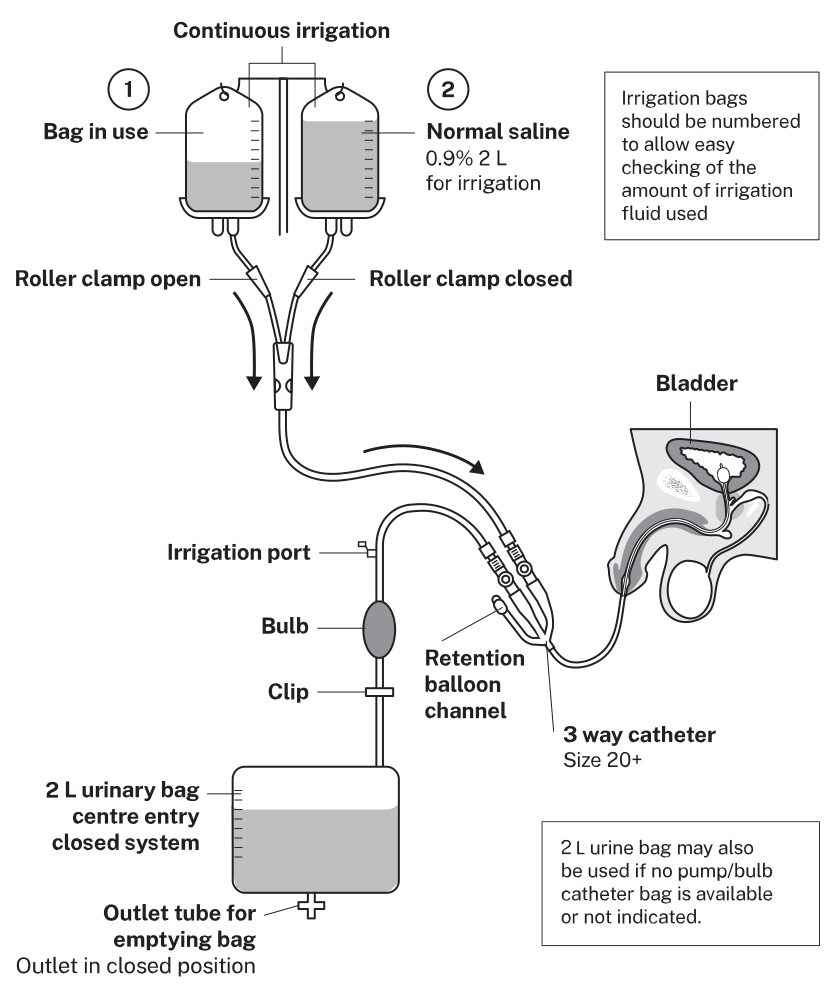
Continuous bladder irrigation (CBI) is used to reduce the risk of clots forming and maintain indwelling urinary catheter (IDC) patency by continuously irrigating the bladder via a 3‑way catheter.
The 3‑way catheter allows fluid to flow in and out of the bladder simultaneously. A large gauge IDC allows for drainage of clots and debris.
The use of 0.9% sodium chloride is recommended. Use sterile equipment and aseptic technique.
Monitor continuous bladder irrigation closely to ensure adequate outflow, prevent overdistension, and promptly identify increased bleeding or obstruction.
Before undertaking the procedure, the nurse, medical officer or student should be able to demonstrate an understanding of the procedure and be able to carry it out safely, in accordance with the standards and protocols established by the local health district (LHD) or healthcare provider.
Equipment
Personal protective equipment (PPE)
Alcohol‑based hand rub
Dressing trolley
Dressing pack
1 or 2 sodium chloride 0.9% irrigation bags, as per LHD policy (irrigation bag volume as per facility procedure)
Cleaning wipes, as per LHD supply and environmental cleaning protocols
6 x alcohol swabs, as per LHD supply (70% alcohol swabs or 2% chlorhexidine and 70% alcohol swabs)
CBI set
IV pole
Sterile gloves
Waste bag
Disposable underpad
Equipment set-up for continuous bladder irrigation.
Continuous irrigation
Continuous bladder irrigation procedure
Continuous bladder irrigation aims to remove clots, restore urinary drainage and maintain catheter patency. Throughout the procedure:
maintain aseptic technique
minimise contamination
support patient comfort and safety
accurately document outcomes and fluid balance.
Intermittent irrigation
Intermittent bladder irrigation provides clinicians with an effective management option for specific clinical scenarios, when required. It is performed via an existing indwelling 2-way or 3-way catheter using a special urinary drainage system with an irrigation port for instilling irrigation fluid.
Maintain the closed catheter system to minimise risk of catheter-associated urinary tract infection.
This intermittent irrigation system can be used for the following patients:
Patients with moderate haematuria with a 2- or 3‑way catheter. This system can be the first‑line treatment. The catheter does not have to be changed to a 3‑way for continuous irrigation and changed back to 2‑way when haematuria settles.
Palliative patients whose catheters are frequently blocked with clots or debris. This system will minimise the discomfort associated with catheter changes.
Patients with a problematic supra‑pubic catheter. This is preferable to manual irrigation, which repeatedly breaks down the closed catheter system.
Review and consider frequency of prior irrigation. Based on the degree of bleeding, and number of clots or amount of debris returned, consider continuous bladder irrigation.
Irrigation pump bag used for intermittent bladder irrigation.
Irrigation pump bag
Before undertaking the procedure, the nurse, medical officer or student should be able to demonstrate an understanding of the procedure and be able to carry it out safely, in accordance with the standards and protocols established by the local health district (LHD) or healthcare provider.
Equipment
Personal protective equipment (PPE)
Irrigation set (single spike)
Irrigation fluid: 1–2 L sodium chloride 0.9% for irrigation (use IV sodium chloride 0.9% if dedicated irrigation fluid is not available)
Bard irrigation pump bag, or similar (2 L urine collection bag with T irrigation port and hand pump bulb)
Disposable underpad
Cleaning wipes, as per LHD supply and environmental cleaning protocols
6 x swabs, as per LHD supply (70% alcohol swabs, or 2% chlorhexidine and 70% alcohol swabs)
Non‑sterile gloves
IV pole
Irrigation chart or fluid balance chart
Equipment set-up for intermittent bladder irrigation via 2-way catheter (closed system with irrigation pump).
Intermittent bladder irrigation
Intermittent bladder irrigation procedure
Intermittent bladder irrigation aims to remove clots, restore urinary drainage and maintain catheter patency. Throughout the procedure:
maintain aseptic technique
minimise contamination
support patient comfort and safety
accurately document outcomes and fluid balance.
About this resource
Bladder irrigation is a common and important clinical procedure performed across NSW Health hospitals.
It maintains urinary catheter patency, prevents clot retention, supports patient recovery following urological surgery and assists with the management of haematuria. It is undertaken by a range of healthcare professionals, including registered nurses, enrolled nurses, nurse practitioners, medical officers, urology registrars and urologists.
Bladder irrigation is performed frequently across a variety of clinical settings, so healthcare professionals need access to practical, evidence-informed guidance that supports safe, consistent and high-quality care.
This toolkit replaces the 2022 guide Bladder Irrigation: Management of Haematuria.
Why we developed this resource
The Urology Network developed this resource to provide clinicians with accessible, best practice guidance on bladder irrigation practice. It supports clinicians to quickly access guidance at the point of care and promotes a consistent approach across NSW Health services.
The resource addresses the need for contemporary, practical guidance on the 3 key methods of bladder irrigation:
Manual bladder irrigation
Continuous bladder irrigation
Intermittent bladder irrigation
It also provides information on equipment, documentation requirements, patient care considerations, cultural safety, troubleshooting and clinician competency assessment.
How we developed this resource
We developed this resource through consultation and collaboration with clinicians and organisations involved in urological and continence care across NSW. This included urology and continence nurses, clinical nurse consultants, nurse practitioners, and specialist urologists working in both hospital and community settings.
Representatives from the following organisations provided input:
Local health districts and specialty health networks
Clinical Excellence Commission
Urological Society of Australia and New Zealand
Australia and New Zealand Urological Nurses Society (NSW-ACT Section)
The content was developed through a review of current evidence, clinical practice guidance and expert clinical consensus to ensure information reflects contemporary best practice.
Who this resource is for
This resource has been designed for healthcare professionals working in acute and inpatient settings who are involved in the assessment, management and performance of bladder irrigation for adult patients. It supports both experienced clinicians and those developing competence in bladder irrigation practice.
Considerations for culturally safe care
Care should be sensitive to cultural, religious and interpersonal differences, including (but not limited to) sexual orientation, gender identity, and physical and intellectual abilities.
As bladder irrigation involves close personal care and can be a sensitive procedure, clinicians should:
use clear, respectful communication
seek patient preferences, including clinician gender, where possible
provide culturally safe, trauma-informed care.
Engage a professional interpreter service for individuals, their partners or support people who are deaf and hearing impaired, or from culturally and linguistically diverse backgrounds. Interpreters can be accessed via NSW Health Care Interpreting Services.
Provide care in a culturally safe and responsive way. For Aboriginal patients, include Aboriginal Health Workers and Aboriginal Liaison Officers in care pathways to help promote cultural safety, assist with navigating the health system, advocate for patient needs, and facilitate effective communication.
Bladder irrigation may be considered sensitive for many Aboriginal women, often recognised as Women’s Business, and should be approached with privacy and respect. Where possible, offer care from female clinicians to support cultural preferences.
Clinicians should take time to yarn with patients and engage in respectful, open conversations about their care. This helps clinicians understand individual preferences, avoid assumptions and, where appropriate, involve family or community supports. These discussions should:
be guided by what is important to the patient
be informed by best clinical practice
use plain language and culturally appropriate resources.
Shared decision-making is important when making decisions in healthcare. The Finding Your Way shared decision-making model is a holistic, 2-way process where Aboriginal people and clinicians make decisions together.
Acknowledgements
We recognise and thank the following people who were involved in the development of this resource.
Tammie Jones, Clinical Nurse Consultant, John Hunter Hospital and Co-Chair, Urology Network
Creative Commons Attribution-ShareAlike 4.0 International License. For current information go to: aci.health.nsw.gov.au
The ACI logo and third party tables are excluded from the Creative Commons licence and may only be used with express permission.
Publication date 2026-08-31.
Accessed from https://aci.health.nsw.gov.au/networks/urology/resources/bladder-irrigation