Aboriginal and Torres Strait Islander people should be aware that this page contains images of deceased persons.
Our project team conducted Aboriginal community-led, co-creation research on country at Uralla/Armidale and Narrabri to address bladder control issues.
Elders and community led this project from the outset, with their cultural advice and decisions informing every step. Community was represented by members of the Narrabri Aboriginal Women Interested in Women’s Health group, and members of the Tablelands Community Support Elders Group - Armidale and Uralla. Aboriginal and non-Aboriginal HNELHD clinicians acted on the advice and decisions of the Elders and provided appropriate support and infrastructure.
Urinary incontinence affects 25% of adult Australians. We had recently completed an implementation project in Hunter New England Local Health District (HNELHD), co-created with clinicians, that successfully improved continence care on adult hospital wards. However, we did not apply an Aboriginal cultural lens.
For this project, we wanted to address this gap by developing solutions that are culturally appropriate and beneficial for Aboriginal adults. For Aboriginal people, bladder control can be a difficult subject to speak about and seek advice and treatment. We used a strengths-based approach that emphasised empowerment, self-determination and collaborative relationships to foster positive change in a culturally safe environment.
As co-creation leads to better patient outcomes, the project team focused on developing authentic engagement, trust and respect, with Elders and community leading the project. This resulted in knowledge sharing despite the sensitive topic. For many Elders, this was the first health-related project they had been involved in. We used a co-creation framework based on the 3-phase Design Thinking Framework for Healthcare using research-topic yarning, with 24 Aboriginal Elders and community members, 12 Aboriginal and 24 non-Aboriginal clinicians.
Starting with consultation
We organised yarns with 4 local communities from metropolitan, regional and rural locations in the district. Led by the Aboriginal clinicians, we used Aboriginal ways of working: getting the word out to community and inviting people to come and yarn about bladder control issues.
We asked the Aboriginal community if this issue was important to them, and if they wanted to be involved in the project to improve health outcomes around this sensitive topic.
“It’s embarrassing, ya know,” was a comment repeated often.
Elders recognised that bladder control was a big issue in their community, and most people did not speak up and seek help for the issue. Community groups from 2 locations chose to be involved. The first was a well-established Uralla/ Armidale Elders group, and the second was a group of women in Narrabri who came together specifically for the research project.
The importance of Aboriginal leadership
The Elders and community led decision-making on the ethics application process, rather than the researchers. One Elder told us: “We are not ready for ethics. We are still in the consultation phase. We don’t know what we don’t know.”
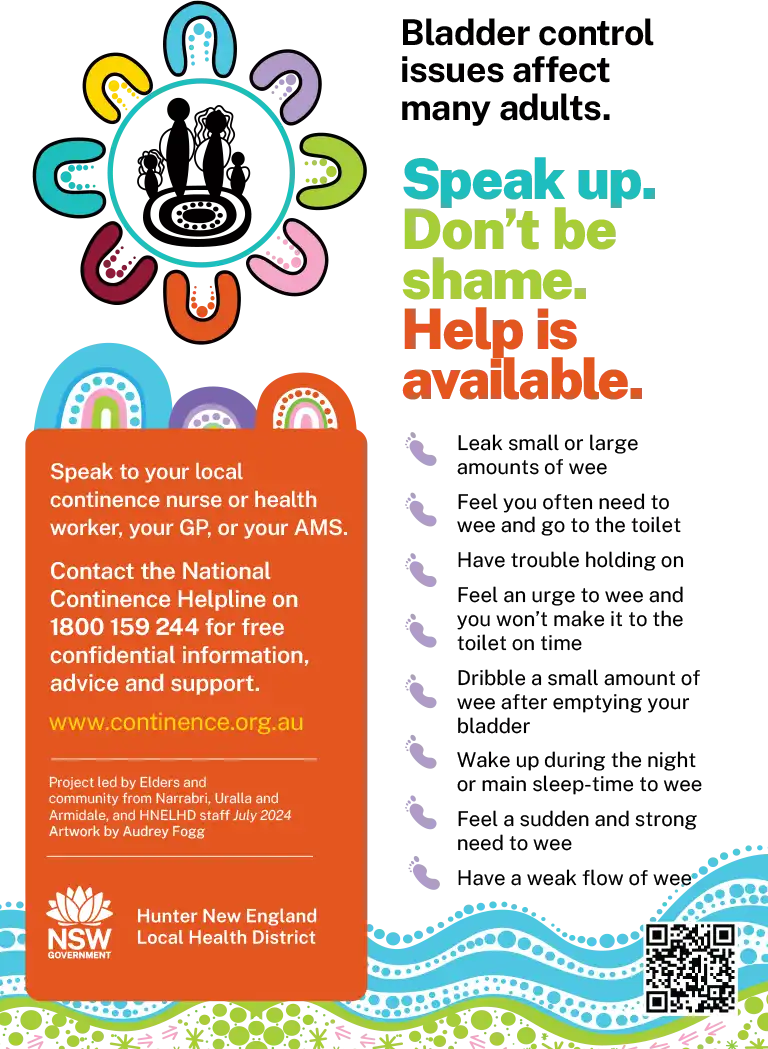
We co-created the ethics materials including a yarning guide, a distress guide, a consent form, and a 2-page participant information sheet summary. Elders recognised that low literacy, as well as lack of knowledge and safety about continence problems, were big issues. They decided what information was key to their community in their words, written in large font, and using appropriate Aboriginal artwork.
A representative from each Elders group, Aunty Ann and Aunty Pam, were members of the project team and Cultural Advisory Group. The group provided cultural and strategic leadership, helped to build cultural safety, and ensured appropriateness of all project-related matters. Combined project team and Cultural Advisory Group meetings were held approximately every 6 weeks virtually; clinicians transported the Elder representatives, and they joined the meetings together from HNELHD telehealth rooms. It was “powerful for the 2 communities to link and connect with each other throughout the project”.

Co-creating culturally appropriate solutions
We aimed to develop culturally safe places where people felt comfortable sharing their stories, feeling part of a group rather than isolated and alone. Elders felt safe with local Aboriginal clinicians leading the project alongside them. The Elders said it was like sitting down with family and friends to have a good yarn, and not clinical. Yarning, sharing food, building trust, and sharing humour despite the sensitive topic were all important to building this safe environment.
We held multiple yarns with Elders, community, Aboriginal and non-Aboriginal clinicians and managers at each phase. In phase 1, all groups identified that the key barrier was a lack of knowledge and awareness. In phase 2, Elders and community identified that solutions should:
- destigmatise bladder control issues and remove embarrassment
- address men’s and women’s business
- encourage speaking up
- highlight that many adults experience symptoms that impact quality of life
- outline common symptoms and causes and where to get help.
Aboriginal staff wanted more knowledge about continence and referral pathways to help improve health outcomes for community. Non-Aboriginal staff wanted knowledge to deliver culturally safe continence care.
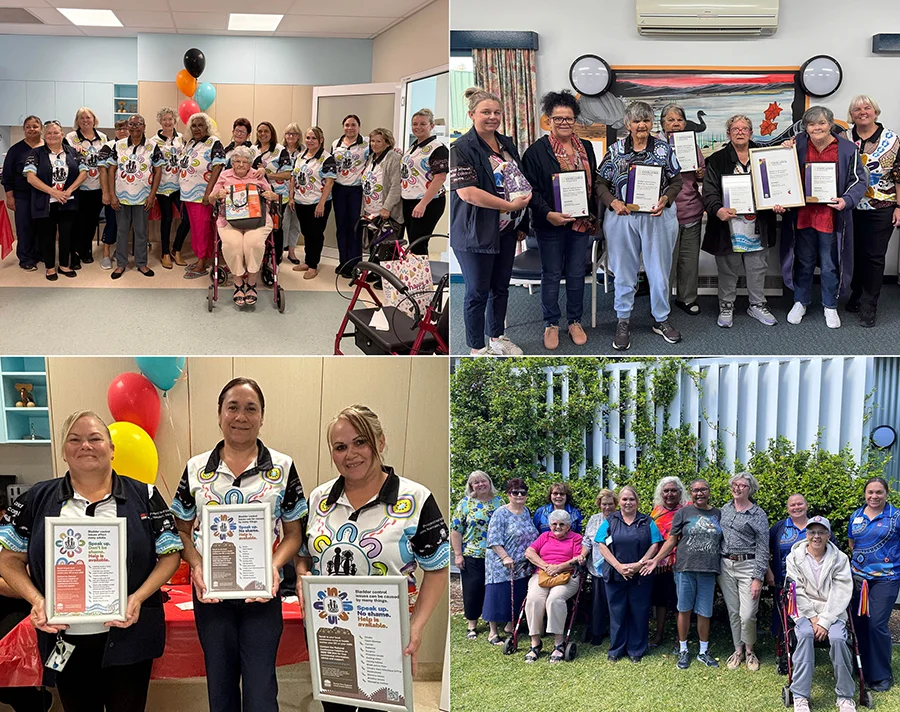
Elders and community reducing stigma about bladder control issues
In phase 3, we developed solutions including the following:
- Elders determined project-specific artwork was key to tell stories and build connections. We sourced the artworks through the culturally appropriate Aboriginal Health Unit Expression of Interest process for procuring Aboriginal artwork for use by HNELHD. Discussions between the Elders, community, team clinicians, artists, continence experts, digital designers and suppliers ensured artwork and messages were right for each promotional resource.
- In October 2024, we launched promotional resources to start conversations, using the artwork and community’s own words. These included posters, shirts, postcards, bags, pens and magnets. Continence experts ensured information was clinically accurate, while Elders ensured the language was appropriate for their community e.g. "bladder control issues" instead of "incontinence". To reduce stigma, Uralla/Armidale Elders chose "No shame" and Narrabri Elders "Don’t be shame" as these were expressions used in their communities.
- Elders and community reviewed Continence Foundation awareness videos and selected 2 that were appropriate for Aboriginal people. These are shown in 29 HNELHD ED waiting rooms.
- We are currently developing web-based clinician education modules.
The team has developed knowledge, skills and confidence in Aboriginal community-led co-creation research and continence, that we are passing on. As one clinician said, “It’s the ripple effect - one person can influence many in a positive way”.
Elders and community are reducing stigma around bladder control issues, educating their communities about the importance of seeking help, and have gone from "living in silence and isolation" to sharing their stories. Clinicians in HNELHD are empowered to raise bladder control issues with their patients.
The 5 Aboriginal and 3 non-Aboriginal HNELHD clinicians are co-presenting at forums and conferences to share learnings. This has built confidence and inspired the Aboriginal clinicians to have a voice.
This project highlights how co-creation, not consultation, leads to better health outcomes, strong relationships and solutions that communities are proud to call their own. It is about the journey along the way and not just the end result.