There is currently no statewide solution within NSW Health to capture LGBTIQ+ demographics, such as gender, sex and sexuality in data collection.
This makes it challenging to collect data in line with best practice, affirming care for LGBTIQ+ clients. While work to address this problem is ongoing, there are many ways to improve LGBTIQ+ affirming data collection in the current system.
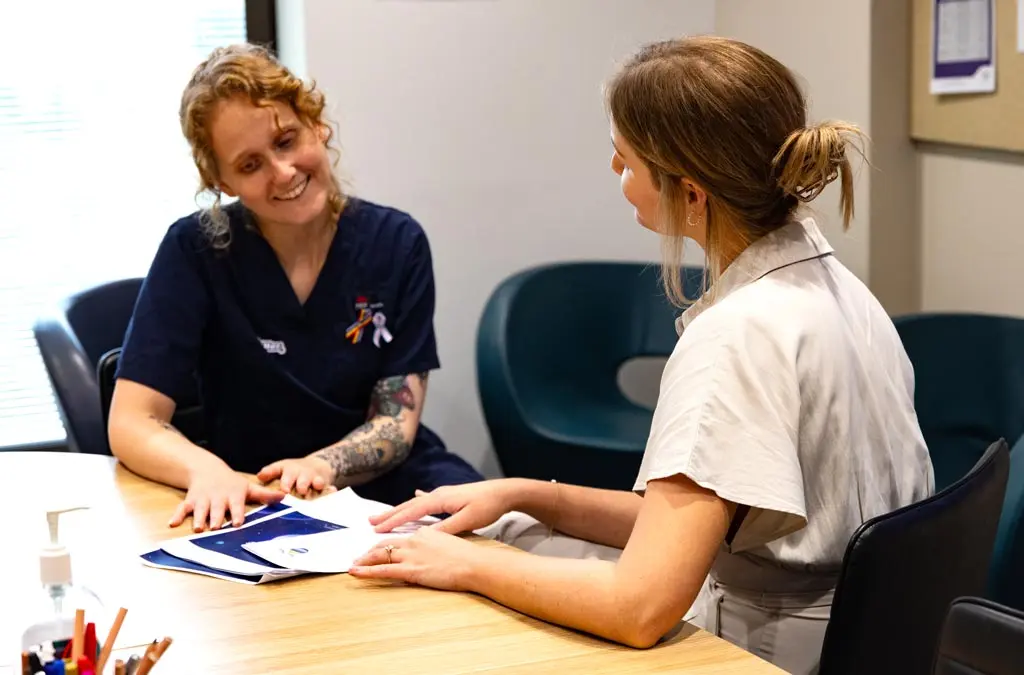
Respectfully asking a client for information about their experience and identity when they first have contact with your service, or when they disclose new information about themselves, is an essential part of affirming practice. This could be captured in a ‘Getting to know you’ form or process, or a more informal data collection agreement that covers the areas below.
Consent and demographic questions
It’s important your client understands why you are gathering information about their LGBTQ+ identity and/or intersex variation, and that you understand who it is safe to share this information with.
Discuss with them:
- why this information is needed
- what it is used for
- the process of maintaining confidentiality
- who the young person is comfortable for you to share information with
- how every encounter (e.g. phone call, talk with nurse) with a treating team is recorded, so all treating staff have access.
Talking about consent and data collection
This example script covers the information you need to share with the client at the start of an episode of support:
I’m going to ask some questions about your life and how you describe yourself. I want you to know who can see this information, and we can talk about what stuff you’re okay with me recording.
This information can be accessed by any NSW Health treating team in this local health district. Our [name] Local Health District is the area from [location] to [location]. So that means people from other teams, or at the hospital could be able to see this information [give some examples for your local health district].
It’s also good to know that NSW Health staff at other services will ask for your name in the Medicare system and use the gender recorded by Medicare. So if you go to the emergency department, the staff may not look at your CAMHS notes so may not see the identity consent details you have given me. This isn’t because they don’t care, it’s because it might not be relevant to your healthcare at the time.
So as I go through these questions, you let me know if it’s ok to record the answers on the system.
Intake template
To ensure you capture information important to your client’s identity and safety, include the following questions and fields. Thanks to the South West Sydney Local Health District Gender Sphere program for their example of an intake form (PDF 105.9 KB) that collects client information about gender and sexuality.
- Title: Miss, Ms, Mr, Mx, N/A, Other
- Preferred name
- Who is okay to know your preferred name (e.g. family, school)?
- Who is not okay to know your preferred name?
- Name listed on Medicare card
- Gender: Female / Male / non-binary / different identity (free text)
- Who is okay to know your gender identity (e.g. family, school)?
- Who is not okay to know your gender identity?
- Gender listed with Medicare: F, M, X
- Sex recorded at birth
- Were you born with a variation of sex characteristics (sometimes called intersex or differences of sex development)? Yes / No / Don’t know / Prefer not to say
- What are your pronouns? E.g. she/her; they/them; he/they; other (details)
- Who is okay to know your pronouns (e.g. family, school)?
- Who is not okay to know your pronouns?
- Sexuality: heterosexual / gay / lesbian / bisexual / pansexual / queer / asexual / prefer not to say / different identity (details)
- Who is okay to know your sexuality (e.g. family, school)?
- Who is not okay to know your sexuality?
- Emergency contact: Name / Relationship / Phone number
- Does your emergency contact know about your gender / name / pronouns / sexuality?
Parent or carer requests for information
- Parents and carers of young people can apply for access to health information/copies of health records.
- The capacity of minors to consent to the disclosure of their health information is guided by section 5.52 of the NSW Health Privacy Manual for Health Information. The manual states:
- When considering issues of access to, or disclosure of, health records relating to minors, the treating health practitioner should assess the maturity of the patient, in particular their ability to understand the content of the records and consequences of their decision.
- Before disclosing the records of a minor, health staff should consider the content of the record and whether the minor may have any objections to its release. Consideration should be given to consulting with the minor prior to disclosure.
- Principles given as an age guide cover patients:
- less than 14 years of age – parents and legal guardians will generally provide consent
- 14-16 years – patients are generally able to consent; consent should generally also be sought from the parents or legal guardians unless there are strong objections from the patient that are reasonable in the circumstances.
- 16 years and over – patients are generally capable of consenting
- Be mindful of the parents' and carers’ attitudes and treatment of LGBTIQ+ young people, and record it.
Recording identity details and consents
Some CAMHS teams have administration officers to edit data collection, while others are smaller and have their own methods. Ensure there is a standardised process for your team, and all members know how to use it for relevant systems and databases, such as those included below.
Electronic medical record (eMR)
When recording client data in the electronic medical record (eMR), use the personal details section to:
- note in contact details how the client wants to be addressed with family members or community
- record the client’s Medicare name first in brackets, followed by their chosen name, e.g. (Alexander) Amy Smith
- If the client uses their chosen name and pronouns openly in all spaces, record them in ‘visit reason’ (as this field is easily accessible beyond the treating team).
In an ISBAR
An ISBAR for an individual client in NSW Health includes:
- Identification of patient
- Situation and status
- Background and history
- Actions and accountability to senior team member
- Responsibility for risk management
The below example shares how to capture affirming data for the ‘I’ step:
- Name in useMedicare namelast nameis an agetrans male (he/him, presumed female at birth), who has been known toservice namesincemonth/year.
- Established diagnoses ofdetails.
- Managed by provider name for medical gender-affirming care.
- List of prescribed HRT medicationname, dosage, method of administration if relevant, associated medical affirmation interventions.
- Well supported byGP name/practicewho he sees on a regular basis.
Progress notes
Record identity and consent in progress notes. Write a new progress note and change the demographic details in the eMR if there are any changes to details regarding information sharing, consent, name, gender, pronoun or sexuality.
Copy and paste the following at the top of all progress notes to capture pronouns and identity:
- “Medicare name/chosen nameistrans, gender diverse. Their preferred name is [XX] and pronouns are [XXX], which will be used for the remainder of the notes”.
Consent should also be captured in progress notes, and have the following inclusions.
Consent in CAMHS
- Current agreement
Consent externally
- Family: current agreement
- School: current agreement
- NSW Health: current agreement
- GP: current agreement
- Psychologist: current agreement
Example of a progress note outlining consent
Consent in CAMHS
- Alice and author discussed communications about her support with other NSW Health practitioners.
- Current agreement: it was agreed that I would refer to her as Alice and she/they pronouns, and that I will provide Alice’s Medicare or legal name if necessary.
Consent externally
- School: Alice also noted that her school is affirming of her chosen name and pronouns. Current agreement: use Alice and she/they pronouns with school.
- Family: Alice’s family do not accept her identity. Current agreement: use Alexander and he/him pronouns with family for safety reasons.
Internal communication
To ensure respect for your client and to give important context for their mental health experience, include the client’s name, pronouns, gender and sexuality when you are communicating with other clinicians.
In the following meetings and communication contexts, include a sentence such as “Medicare name/chosen name is trans, gender diverse. Their preferred name is Dee and pronouns she/they.”
- Mental health current assessment
- Mental health past history
- Multidisciplinary team discussion progress note
- Mental health care plan
- Mental health wellness plan/safety plan
- Mental health review
External communications and meetings
For external communication, such as a mental health discharge summary, discharge letter to family or meeting with external service providers, e.g. family, school or service providers:
- discuss with the client how they would like to be identified in external notes or in meetings
- refer to the client according to the agreed consent for the people/organisations being communicated with (even if they differ to the name and gender you have been using throughout the period of support)
- use the opportunity to demonstrate allyship with the client for stakeholders who know about a young person’s identity but are not affirming, e.g. when meeting with parents who misgender their child.